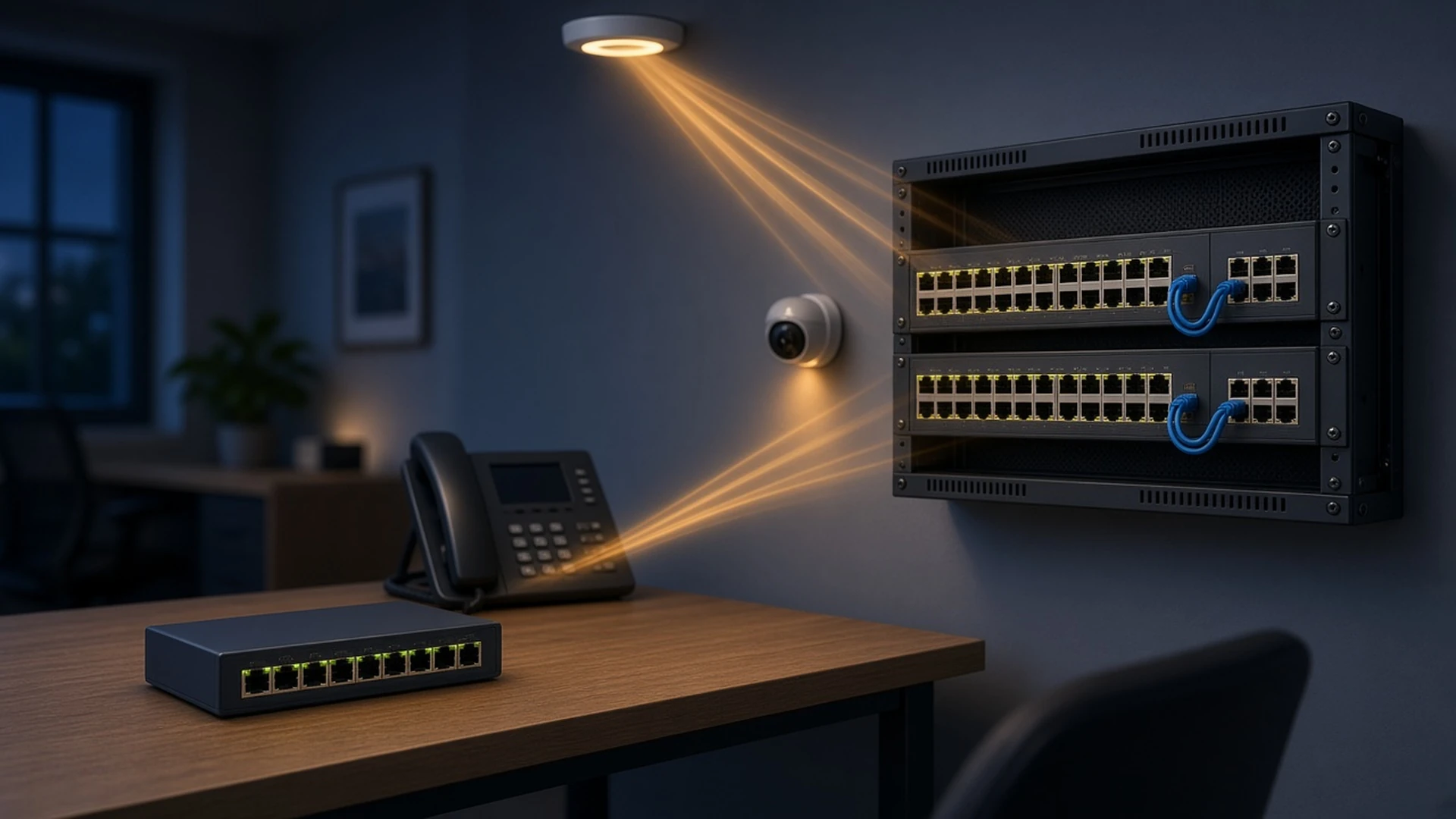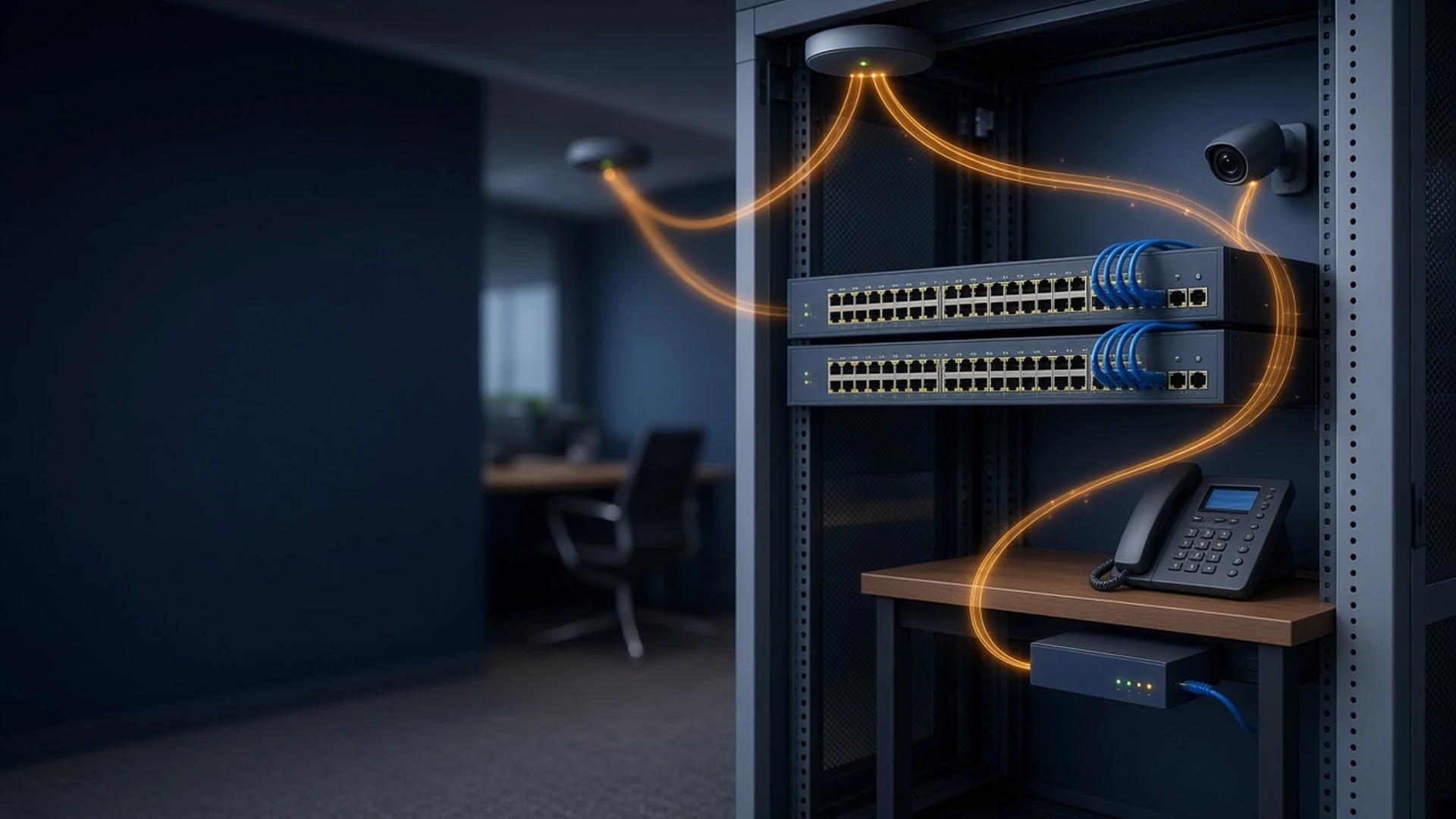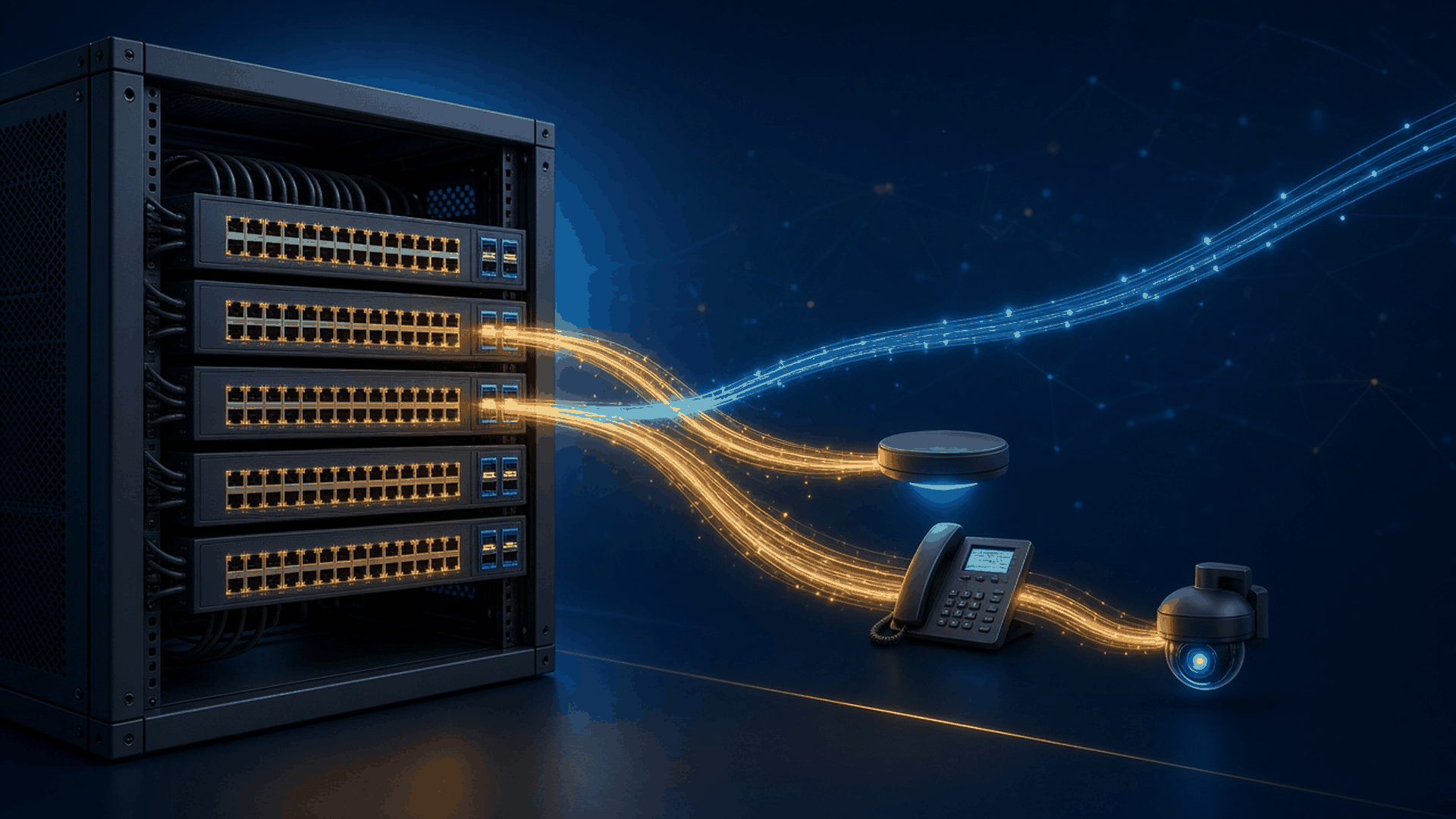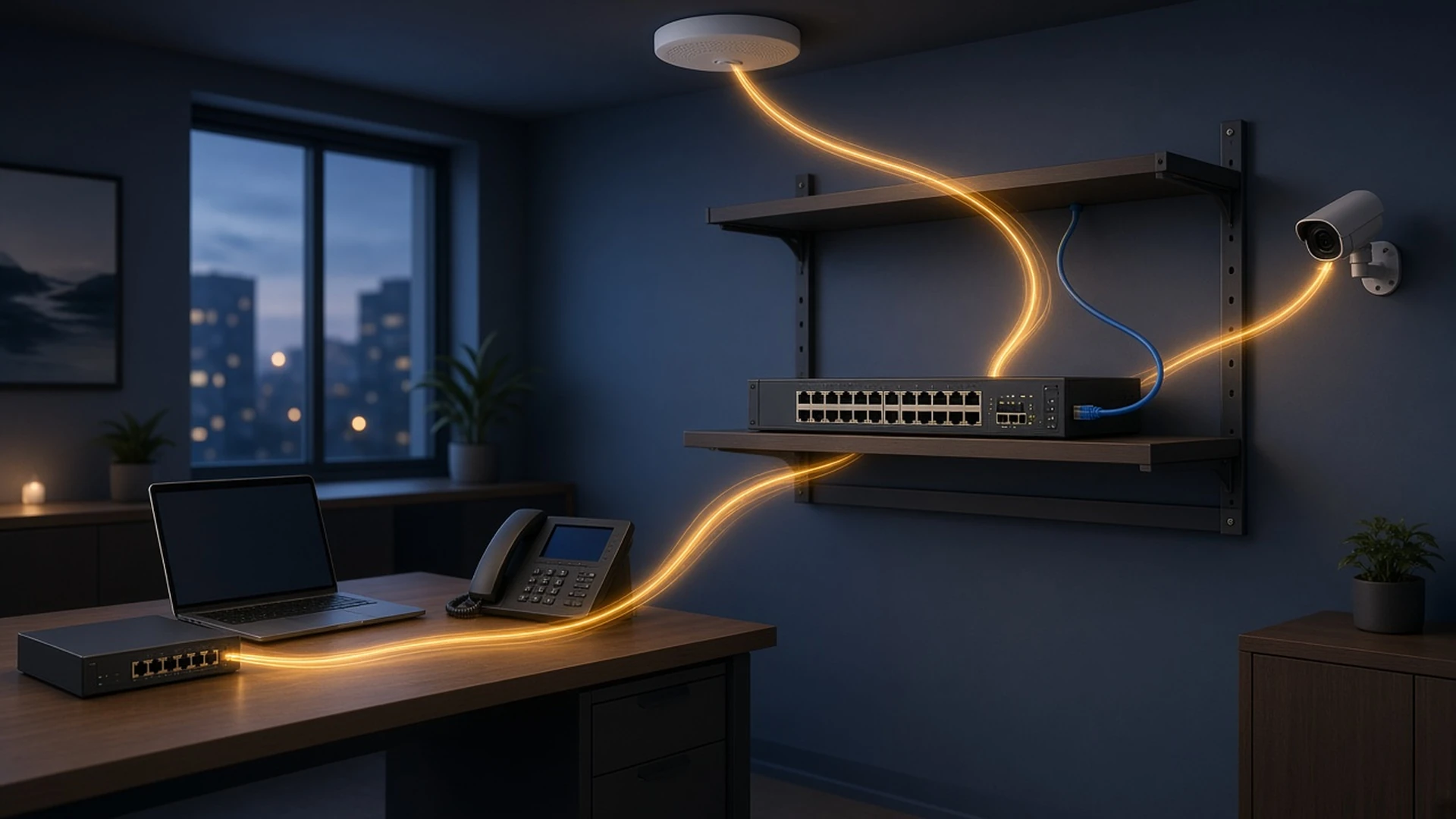
Cisco Catalyst 1200 Series switches are affordable, fixed managed switches for small and medium-sized businesses. The range runs from a compact 8-port desktop switch to 48-port PoE+ rack switches with 10G uplinks, and every model adds Layer 3 static routing to Layer 2 switching. You can browse our current listings in the Cisco Catalyst 1200 Switches category.
This guide maps those listings to Cisco's Catalyst 1200 data sheet so you can quote the right part number the first time, and shows where the 1200 stops and the Catalyst 1300 begins. If you are still choosing between switch series, start with the Cisco Switch Buying Guide.
Short answer: Pick a Catalyst 1200 for a standalone switch in a small office, shop, or classroom that needs managed VLANs, PoE+ for phones, cameras, and access points, and a few static routes. For most closets that means a 24-port PoE+ model with 10G uplinks, such as C1200-24P-4X. If you need stacking, dynamic routing, Multigigabit ports, or more than 375W of PoE, step up to the Catalyst 1300. On our listings, -RF means refurbished.
What is the Cisco Catalyst 1200 Series?
The Catalyst 1200 is Cisco's entry line of managed business switches. It runs Cisco's customized Linux-based software and offers Layer 2 switching plus Layer 3 static routing, a combination often called Layer 2+. You manage it through a built-in web interface, a full CLI, SNMP, the Cisco Business Dashboard, or the Cisco Business mobile app.
Every model gives you IEEE 802.1X access control, MAC-based port security, storm control, DoS prevention, up to 512 ACL rules, eight hardware QoS queues, voice and auto surveillance VLANs, and up to 255 active VLANs. Smartports apply QoS and security settings by device role, Cisco Network Plug and Play eases rollouts, and dual firmware images make upgrades safer. Each switch has 1 GB of DRAM and a dual-core 1.4 GHz ARM CPU, and Cisco rates all models wire-speed and nonblocking.
How do you read a Catalyst 1200 part number?
Read it left to right: series (C1200), access-port count, port type, then the uplink code, with -RF added on our refurbished listings. For example, C1200-48P-4X is a 48-port Gigabit switch with PoE+ on a 375W budget and four 10G SFP+ uplinks.
- Port types: T = Gigabit data only; P = Gigabit PoE+ (on a smaller budget on 8-, 16-, and 24-port models); FP = Gigabit PoE+ with the full budget.
- Uplinks: -2G = 2×1G, combo copper/SFP on 8-port models and SFP on 16-port models; -4G = 4×1G SFP; -4X = 4×10G SFP+.
- Desktop model: C1200-8T-D has eight Gigabit ports, no uplink ports, and no RJ-45 or USB-C console port, and it can be powered by 802.3af PoE on port 1 instead of its adapter.
- Exact PIDs: the 8-port rack-mountable data and PoE+ models are written C1200-8T-E-2G and C1200-8P-E-2G, so copy the -E exactly when you order.
- Condition: -RF means refurbished on M&F Collaboration listings, for example C1200-48P-4X-RF.
Which Catalyst 1200 model fits your site?
Match the model to the space and the uplink: an 8-port model for a desk, shelf, or small cabinet, a 16-port model for a small office, and a 24- or 48-port model for the main closet. Choose -4X uplinks when the switch connects to a 10G core, server, or firewall.
| Group | Models on our site | Access ports | Uplinks | PoE budget | Cooling |
|---|---|---|---|---|---|
| 8-port | C1200-8T-D, C1200-8T-E-2G, C1200-8P-E-2G, C1200-8FP-2G | 8×1G | None on C1200-8T-D; 2×1G combo on the others | 67W (8P-E) or 120W (8FP) | Fanless |
| 16-port | C1200-16T-2G, C1200-16P-2G | 16×1G | 2×1G SFP | 120W (16P) | Fanless |
| 24-port, 1G uplinks | C1200-24T-4G, C1200-24P-4G, C1200-24FP-4G | 24×1G | 4×1G SFP | 195W (24P) or 375W (24FP) | Fanless, except one fan on 24FP |
| 24-port, 10G uplinks | C1200-24T-4X, C1200-24P-4X, C1200-24FP-4X | 24×1G | 4×10G SFP+ | 195W (24P) or 375W (24FP) | Fanless, except one fan on 24FP |
| 48-port | C1200-48T-4G, C1200-48P-4G, C1200-48T-4X, C1200-48P-4X | 48×1G | 4×1G SFP or 4×10G SFP+ | 375W (48P) | One fan |
Every model except C1200-8T-D is rack-mountable and has an RJ-45 and a USB-C console port. C1200-8T-D, C1200-8T-E-2G, and C1200-8P-E-2G run from an external power adapter; every other model has an internal universal power supply. Switching capacity runs from 16 Gbps on C1200-8T-D to 176 Gbps on the 48-port -4X models.
How much PoE budget do you need?
Add up the watts of every powered device, then pick a model whose total PoE budget covers it with headroom. Each PoE+ port on a Catalyst 1200 delivers up to 30W, but the switch budget is the real limit: C1200-24P-4X shares 195W across 24 ports, while C1200-24FP-4G has 375W for the same port count.
Phones and small cameras: C1200-8P-E-2G has 67W, and C1200-16P-2G and C1200-8FP-2G have 120W, which suits a handful of phones or cameras at a reception desk or small shop. The 24-port P models carry 195W.
Access points and PTZ cameras: the FP models and the 48-port P models carry 375W. That is enough for 12 devices drawing a full 30W, or about 15W on all 24 ports of an FP model, so check the real draw of your devices. Size access points with our Cisco wireless access point buying guide.
PoE features: every PoE model supports 802.3at PoE+, 802.3af, and Cisco prestandard PoE. Perpetual PoE keeps devices powered while the switch reboots, and time-based PoE can turn ports off after hours. The 1200 has no 60W PoE++ ports.
Catalyst 1200 vs Catalyst 1300: which should you buy?
Choose the Catalyst 1200 when one switch per site is enough and static routes cover the routing. Choose the Catalyst 1300 when switches must stack, routes must be learned dynamically, the network needs Multigigabit or 10G access ports, or devices need more than 375W of PoE per switch. Neither series needs a software license.
- Stacking: Cisco does not list stacking for any 1200 model. Catalyst 1300 -4X, Multigigabit, all-10G, and C1300X models stack up to eight switches with a single IP address; the 1300 -2G and -4G models do not stack either.
- Routing: the 1200 is limited to 32 static routes and 16 IP interfaces. The 1300 adds RIPv2 and policy-based routing, up to 990 routes and 128 IP interfaces on C1300, and OSPF on C1300X.
- Security and scale: the 1300 adds DHCP snooping, dynamic ARP inspection, and IP Source Guard, which Cisco's 1200 data sheet does not list, and supports up to 4,094 VLANs against 255 on the 1200.
- Ports and power: the 1200 offers Gigabit access ports only, with PoE budgets up to 375W. The 1300 adds 2.5G and 5G Multigigabit and all-10G models, budgets up to 740W, and 60W PoE++ on C1300X.
Compare models in Cisco Catalyst 1300 Switches; for example, C1300-24P-4X matches C1200-24P-4X on ports and its 195W budget but adds stacking. For IOS XE and enterprise campus features, look at Cisco Catalyst 9200 Switches, which are ordered with a Cisco Networking Subscription in the Switching Essentials or Switching Advantage tier.
Uplinks and optics for the Catalyst 1200
Cisco's supported-module list for the 1200 includes 1G SFPs such as GLC-SX-MMD, GLC-LH-SMD, GLC-TE, and MGBSX1, and 10G SFP+ modules such as SFP-10G-SR, SFP-10G-LR, and SFP-H10GB-CU1M twinax cables for -4X uplinks. Order one module per uplink you plan to use, and add a second link if you want an LACP bundle to the core.
What should a Catalyst 1200 RFQ include?
Confirm these items before you request a quote so we can match the switch, PoE budget, and optics in one quote.
- Port count and type: data only, PoE+, or a desktop model
- Number of powered devices and total PoE watts per switch
- Uplink speed (1G or 10G) and one SFP or SFP+ module per uplink
- Routing needs: whether static routes are enough, or you need RIPv2 on a Catalyst 1300 or OSPF on a C1300X
- Mounting and noise: desk, wall, or rack, and whether the space needs a fanless model
- Condition: new or refurbished (-RF), plus quantity and delivery date
Cisco Catalyst 1200 FAQ
What is the difference between Catalyst 1200 and Catalyst 1300?
Catalyst 1200 is a standalone managed switch with static routing only: up to 32 static routes, 16 IP interfaces, and 255 active VLANs. Catalyst 1300 adds front-panel stacking on its -4X, Multigigabit, all-10G, and C1300X models, RIPv2 dynamic routing, DHCP snooping, up to 4,094 VLANs, 2.5G, 5G, and 10G access ports, and PoE budgets up to 740W.
Can Catalyst 1200 switches be stacked?
No. Cisco's Catalyst 1200 data sheet does not list stacking for any model, so each switch is managed on its own or through the Cisco Business Dashboard. If you need several switches managed as one system with a single IP address, choose a stackable Catalyst 1300 model.
Are Catalyst 1200 switches fanless?
Every 8- and 16-port model is fanless, as are C1200-24T-4G, C1200-24P-4G, C1200-24T-4X, and C1200-24P-4X. The exceptions are C1200-24FP-4G, C1200-24FP-4X, and all four 48-port models, which each have one fan.
Do Catalyst 1200 switches need a software license?
No. Cisco's ordering table for the Catalyst 1200 lists only hardware part numbers, and Cisco states there are no licenses to purchase for the 1200 and 1300 series, with software updates at no additional cost.
What does -RF mean on a Catalyst 1200 listing?
On M&F Collaboration listings, -RF means refurbished. For example, C1200-24P-4X-RF is a refurbished C1200-24P-4X. Ask us for the warranty terms on refurbished units with your quote.
About this guide
Prepared by M&F Collaboration, a B2B reseller of Cisco networking, collaboration, power, and UCS hardware based in West Chicago, Illinois. Model, port, PoE budget, cooling, and routing details were checked against Cisco's Catalyst 1200 data sheet, and the Catalyst 1300 comparison against Cisco's Catalyst 1300 and 1300X data sheet. When a marketplace listing title disagrees with Cisco's data sheet, we follow the data sheet.
Need a Catalyst 1200 quote?
Send us your port count, powered devices, uplink speed, and mounting plan. We will match the 1200 model and the optics, new or refurbished, so the office BOM is complete.
Prefer to browse first? Explore these categories: